You've Got Mail is a message-in-a-bottle newsletter about change. How it feels, how we navigate it, how we work with others to shape our world, and how we make strategic decisions inside it. Here I share decision-making tools, reflection essays, book recommendations, announcements, and stories to illuminate the threads between systems, change, and the lives we live inside it all.
Easeful Chaos: back to school in a whole new country.
Published 7 months ago • 9 min read
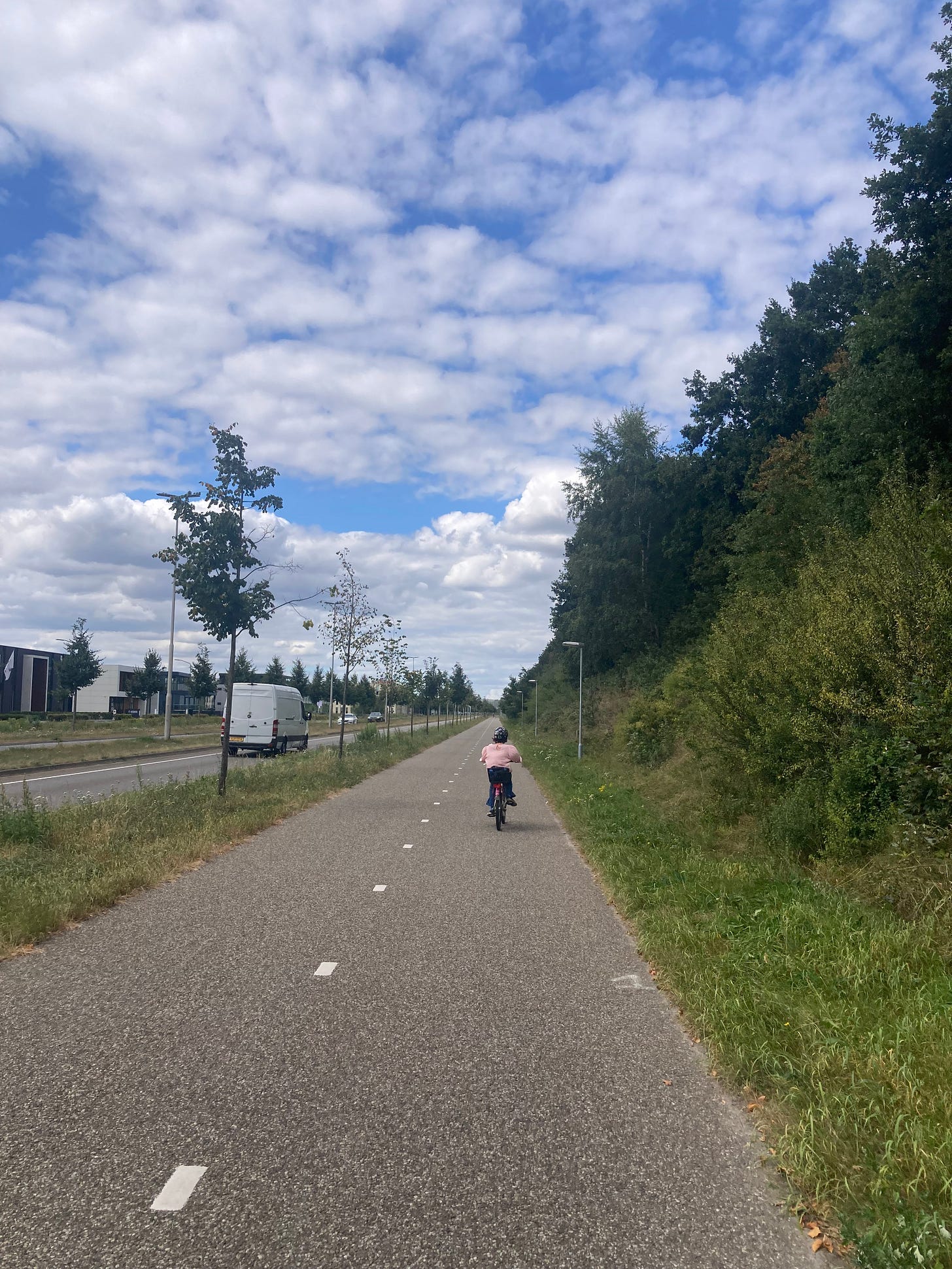
The first morning of school in the Netherlands was a goddamn visual delight.1 I saw a mom with a cargo bike full of small ones following a 2nd grader with a backpack on as he pumped his little legs as fast as he could, excitedly leading the pack. She was surrounded by other kids and parents weaving this way and that, moving along through the easeful chaos of bike culture in the Netherlands.
A sweet bike moment in the quiet weeks before school when at least half the country is on vacation.
Flocks of children flowed down the tributaries of cobblestone streets, turning expertly onto bike paths, dodging the occasional teen trying to text and bike (despite the €160 fine for doing so), then merging together into one solid stream of speed zooming into the secondary school’s bike parking lot. My own kids joined the masses of young people a couple days later as they made their way to their new school, a joint public/private English-language International school. The school is partially funded by the Netherlands government in exchange for adhering to a set of Netherlands guidelines, including teaching all the kids Netherlander (Dutch) and following the NL academic calendar.
Our kids are making friends and learning a new set of independence and responsibility and I’m really damn proud of them. It’s creating a really interesting experience for us all.
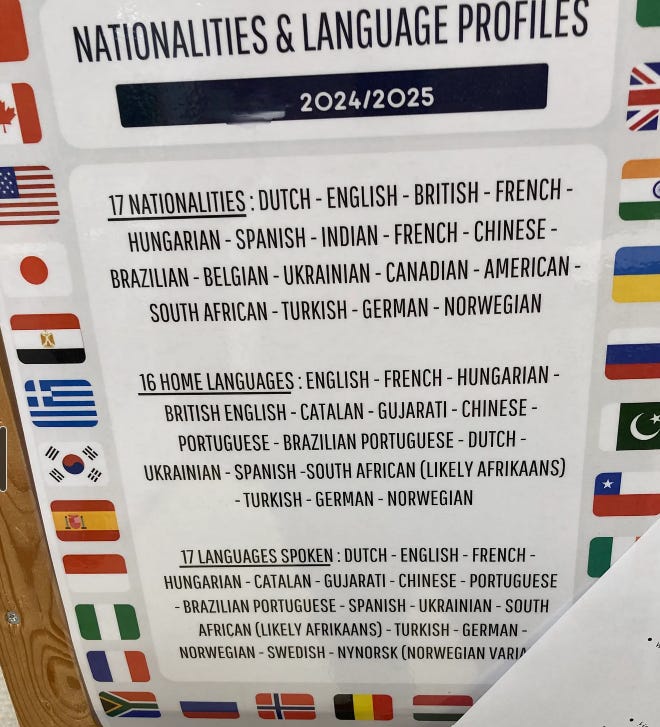
A number of fellow students have English as their home language, but a large portion of students do not speak either English or Netherlander (what we usually call Dutch) as their home language. People are moving in and out of the school and the country throughout the year as their parents jobs take them back home or onwards, so we may be at the beginning of a long relationship with some people, while we may not see others again after a couple of months. It’s the most all-consuming back-to-school we’ve had yet, and that’s to be expected! I have to keep reminding myself that we did a really big thing.2
We are arriving into a country with its own norms about childhood, then trying to set up playdates or get to know people from another culture with another set of norms and expectations while holding onto our own standards, boundaries, and hopes. It’s a lot of awkward and vulnerability. It is humbling.
I’m noticing myself learning to hold our own space and the experiences of others differently than when we were in a neighborhood public school in the US. When I was inside communities in the US, I was always noticing and adjusting how to interact with people around me based on information I had about power and culture shaped by gender, nationality/culture, religion, race, and class. What norms are dominant? Given my class/race/gender experience, what do I feel is the best way to show up and do x, y, z? What are the dynamics of race in this specific community or that? How many people of a similar gender to me are present in the everyday life of a person moving through this town and how much do I have to explain about myself or be on guard? What have the teachers or other parents shown me about how they understand me and my wife and our role as parents?
Here it feels really different. I often have to point out very clearly that my wife and I are together, we’re with the same kids. I’ll write another post sometime about gender and queerness here (which is more notable than I expected). I feel protective of our family’s rights and dignity as queer people, and also mindfully compassionate that I don’t know where people are coming from and what they do or don’t know about queer people, especially genderqueer people from the US, what they’re thinking or feeling. And I’m still trying to see and feel through complexities of race and class here — in the context of the first private-ish school our kids have ever attended, in the context of European-oriented internationalism, in this part of the Netherlands, and the Netherlands in general. It’s a lot going on and it is different than the dynamics of the US. I welcome the day I can read Dutch enough to deep dive into the cultural politics section of the library. For now, curiosity and my own base values are the guide.
The logistics of the USA—> NL school transition
If you’re reading this post because you’re trying to understand how the logistics of someone from the US moves their kids into school in the Netherlands, this next section is especially for you!3
First of all, school in the Netherlands is done in the language of Netherlander/Dutch. If your child doesn’t know Dutch but is really young (3, 4, 5, 6), from what I can tell, they’ll be placed in a regular classroom where they’ll pick up Dutch quickly because tiny humans are sponges for language and these early years are focused on routine and play. If I had small humans I would have happily put them in these classes and watch them quickly assimilate into Dutch kid culture and make fun of my terrible speaking skills. If they’re older than 6, they are put in a “newcomer class,” which sometimes is a whole separate school in the town.4 There, they’ll be mostly/only taught Dutch along with a bunch of other kids who just arrived here, many as refugees. For about a month of my “if we move are we moving to the Netherlands” research, I was fully on-board with this plan.
My kids are not small, and my kids started their education in the pandemic years and THEY WERE TERRIBLE and their disrupted schooling was not okay for their mental health or their learning, IMO. I remember the moment I realized plunking our kids down into the NL public school system was NOT going to be great decision as a parent. It was late at night, I’d just finished kid bedtime and used the light of my phone to guide me down the stairs and onto the couch. Still sitting in the dark, deep in the bowels of some Reddit or other community conversation thread, I re-read one mom’s account of her bookish studious kid being told there was no way she’d be put into the secondary school that funnels kids on to a University. It was as if the camera of my life changed perspective, looking out at the glowing screen, then it hit me.
“Dude. What. Are. You. Doing.”
I’m making massive decisions about my children’s future. That’s what I’m doing.
The school system in the Netherlands, like much of western Europe, uses explicit systems of tracking. The kind of tracking that my education activist friends rail against. As in, at 11 you take a test and your future class status and career path is determined. At 12, kids are sorted into three types of schools:
Vocational tech (VMBO - preparatory secondary vocational education), which only runs for 4 years. At 16, they’ll be ushered into the workforce or another training program like an apprenticeship.
Prep for technical bachelor’s degree (HAVO - senior general secondary education). In the US, I would think of this as a state school that’s not the big Ag or flagship school — think the University of Toledo, where I started my college career, or SUNY Buffalo. For five years, students will prepare to get a bachelor’s degree in a tangible job type, like a video game designer or a project manager. At 17 they’ll finish and presumably start at one of these colleges.5
Prep for the University track (VWO university preparatory education), where they would be ready to study to be a lawyer, a doctor, or a researcher. This secondary school is 6 years long, runs until they’re 18 (as in the US), and teaches them (as far as I can tell) a whole fucking lot that most middle-and working-class public US high schools don’t.
From what I’ve read, almost no students who start learning Dutch in the middle- or end- of their elementary/middle school careers make it to the University track. Add to that, some older kids may be in these classes for two whole years because they literally need a bigger vocabulary to hang in secondary-level classes.
In the US, the approach seemed to go like this: put young people in the English-only classes and let them bang along, not really knowing what was happening, using translator and other English-as-a-second-language support when available. I have heard from some friends what that felt like when they were kids — often not great — and also, some responded to that pressure by learning English really quickly. The Netherlands approach was, it seemed, reversed. They couldn’t sit in class and get along based on secondary clues, peer support, or aggressive use of Google Translate. Instead, it seemed my bookish 12-year-old would miss two full years of learning normal secondary school things and learn only Dutch. I even had a meeting with the head of the bilingual Dutch/English secondary school, asking if she took intensive Dutch classes all summer if she could join. No, he said. She could not.
The Dutch International School System
And so, this is how I fell deep down the rabbit hole of International Schools in the Netherlands. A side-note for those thinking “I’d just home school.” Homeschooling is verboten!6 I personally have never wanted to home school my children, so this information changed nothing about how schooling in the Netherlands would inform our decision to move here.
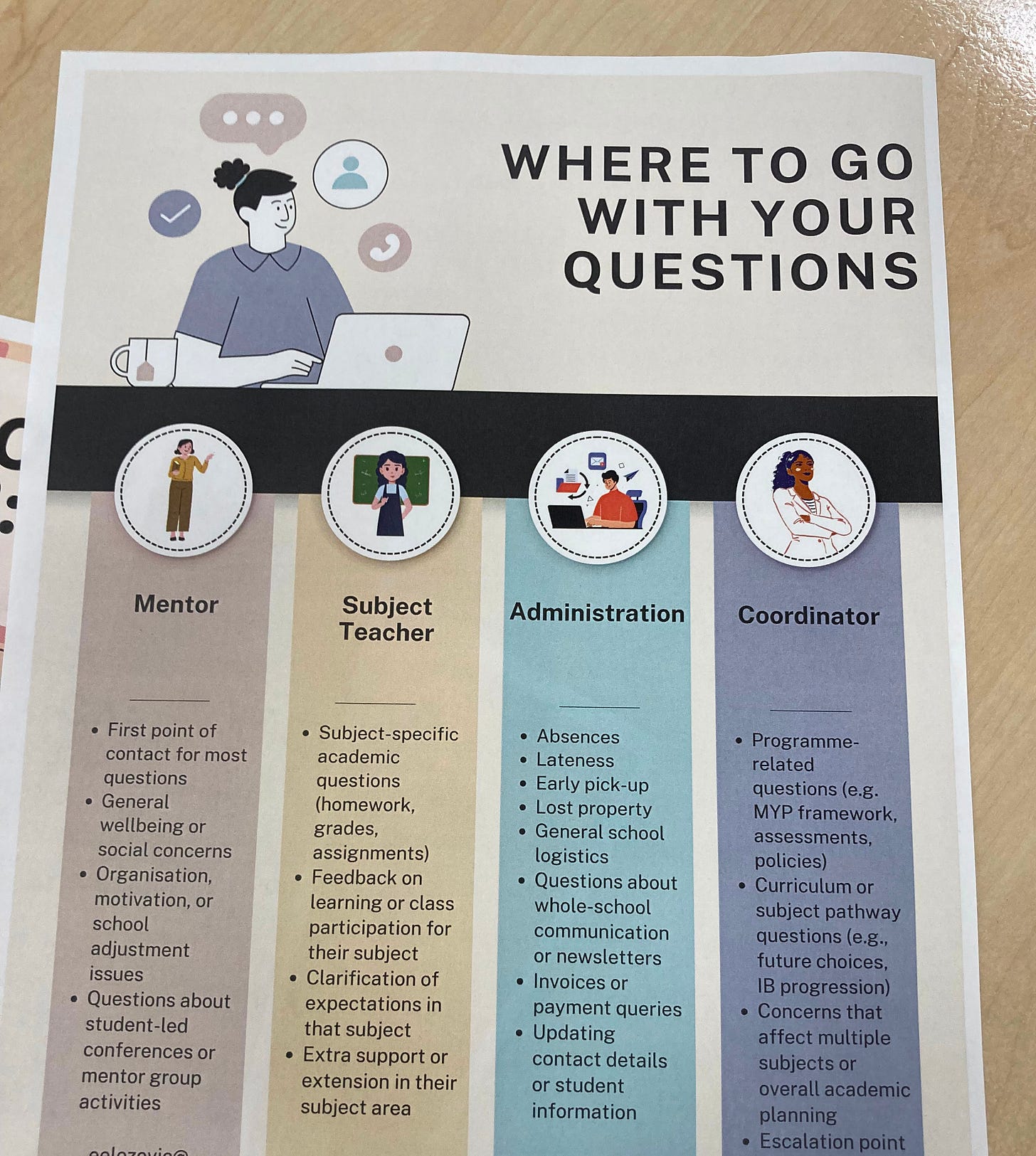
Back to school handout for the secondary student.
There’s a number of different kinds of non-Dutch private schools for students from abroad, but there’s not a system of Dutch private-because-we-like-fancy-exclusivity like there is in the US and England. Private schools are for kids with special needs or kids who haven’t yet learned Dutch. Even the royal family (yes, there’s still a monarchy here) send their kids to the public system.7 In big cities like the Hague and Amsterdam there are private schools focused on different countries of origin — like the British School of the Netherlands or the American School of the Hague. But I am trying to get my kids outside of the American-centric orbit as much as possible, so I didn’t consider that school even for a minute.
Then, I learned about the system of publicly-subsidized private international schools, the Dutch International Schools. As a rah-rah believer in public education, this aligned with my values the most and it cut the cost of tuition by 1/2 to 1/3 of the cost of other schools, making it somewhat, at least for now, within reach for my family. So, I focused our search of schools and cities around International Schools that were part of the Dutch International School system.
Now, full transparency because we should all talk about money more explicitly: the tuition is about 8k euro for each of my kids, divided into two separate payments (before school starts and mid-year). I cashed out the 401k I’d been building during these last 8 years of non-profit employment to pay for the school and this move.8
A housing + school strategy for the DAFT visa
If you’re among the many people looking to the DAFT Visa to get yourself to the Netherlands, you’ll need an address you can register at as an early first step. The Netherlands has a housing shortage, and a DAFT Visa holder doesn’t yet have income in Euros, making us not-so-appealing to housing providers. It’s quite a puzzle, and many people have to take the approach of looking for and taking housing literally anywhere they can. This makes sense! And, if you have kids who need to go to an International school, it can be tempting to fixate on one school and one school only. But, a lot of the schools are full or near capacity every year. You may find yourself in the position we were in: we applied for and signed a lease on an apartment but did not get off the waiting list for the one and only local International school until the school year was almost over. I started to panic researching and applying to other schools, but the reality was we’d signed a lease in one city and commuting to someplace like the Hague would have been a massive hardship.
So, if it’s important for your older child to attend an International school, I encourage you to build flexibility into your planning as much as possible by applying to multiple International schools and housing in multiple cities, if you can.
If you’re a parent who just sent your kids back to school, big solidarity to you. May they be safe and learn in a welcoming community no matter who they are or where they’re learning.
If you’re considering leaving the US (even if flashes of “what if” or “I couldn’t!” cross your mind occasionally) my wife Nova and I wrote a book just for you.
$18.00
PDF Download: Should I Stay or Should I Go Workbook
The Should I Stay or Should I Go Workbook blends warm prose and vibrant worksheets with structured steps to guide you... Read more
You've Got Mail is a message-in-a-bottle newsletter about change. How it feels, how we navigate it, how we work with others to shape our world, and how we make strategic decisions inside it. Here I share decision-making tools, reflection essays, book recommendations, announcements, and stories to illuminate the threads between systems, change, and the lives we live inside it all.